
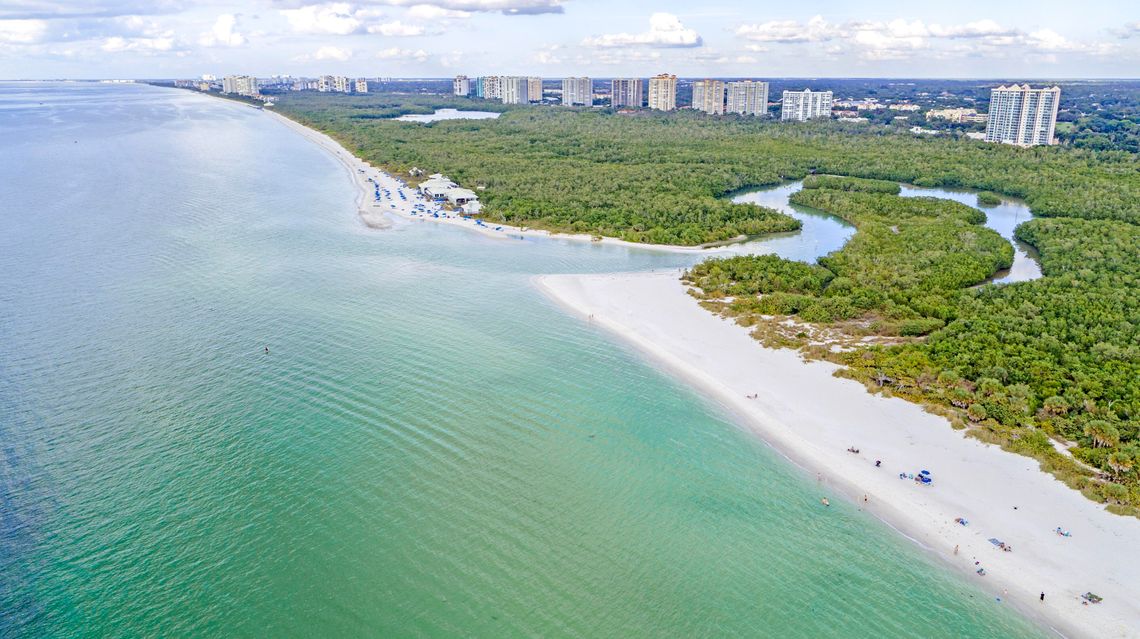
Long before Southwest Florida became one of the country’s fastest-growing regions, local communities were already writing the area’s history — in fishing villages and cattle country, railroad towns and resort communities and along commercial streets and waterfronts. Centuries ago, Indigenous people built communities that have endured for generations. Beyond the new construction and modern amenities, Southwest Florida’s history remains visible in old buildings, street patterns, museums, archaeological sites, working waterfronts and the landscape itself.
Where it began
Old Naples
Naples’ earliest commercial and social center developed near the Gulf, around what is now Third Street South, where Naples began to take shape as a remote resort community in the late 19th century. The Naples Town Improvement Company was formed in 1886, and the Naples Pier was built in 1888, providing an essential connection to a community that was easier to reach by water than by land.
The railroad reached Naples in 1927, and the extension of the Tamiami Trail helped shift commercial activity away from Third Street toward Fifth Avenue South and Ninth Street. Fifth Avenue had already begun emerging as Naples’ unofficial Main Street.
The Naples Historic District still preserves part of the earlier city, in an area between Third Street South and the Gulf. Historic Palm Cottage, built in 1895 and operated by the Naples Historical Society, offers another glimpse into early Naples.
Hurricane Ian caused catastrophic damage to the Naples Pier in 2022, destroying nearly half of the over-water structure. Construction on a replacement began Jan. 6, 2026. The city is rebuilding using more resilient standards, and the pier and its immediate access area remain closed during the approximately 18-month project.
Bonita Springs
Along Old 41 Road, two longtime Bonita Springs landmarks tell much of the story of the city’s origins.
Shangri-La Springs traces its beginnings to 1926, when Gilmer Heitman built the 35-room Bonita Hotel along what was then the Tamiami Trail. The property changed owners, names and uses over the decades before becoming Shangri-La, but its historic buildings and grounds survived while Bonita Springs grew around them. In 2026, the property marked its centennial.
Just down the road, Wonder Gardens began in 1936 as the Reptile Gardens, created by the Piper family as a roadside attraction for travelers along the new Tamiami Trail. It later became Everglades Wonder Gardens. Today, the attraction combines tropical botanical gardens with habitats for rescued and non-releasable birds and reptiles.
Everglades City
Once accessible only by boat, the remote frontier settlement of Everglades City took on a new role in 1923 when it became Barron Collier’s operational base for the construction of the Tamiami Trail and served as Collier County’s first county seat.
The Museum of the Everglades occupies a commercial laundry building, built in 1927. The National Register-listed building has been restored to its 1920s appearance, and its exhibits reach considerably farther back, interpreting more than 2,000 years of human history in the region.
Everglades City remains closely associated with commercial fishing. Its annual seafood festival has celebrated the area’s heritage for more than half a century.
Cities grow up
COURTESY PHOTO
Fort Myers
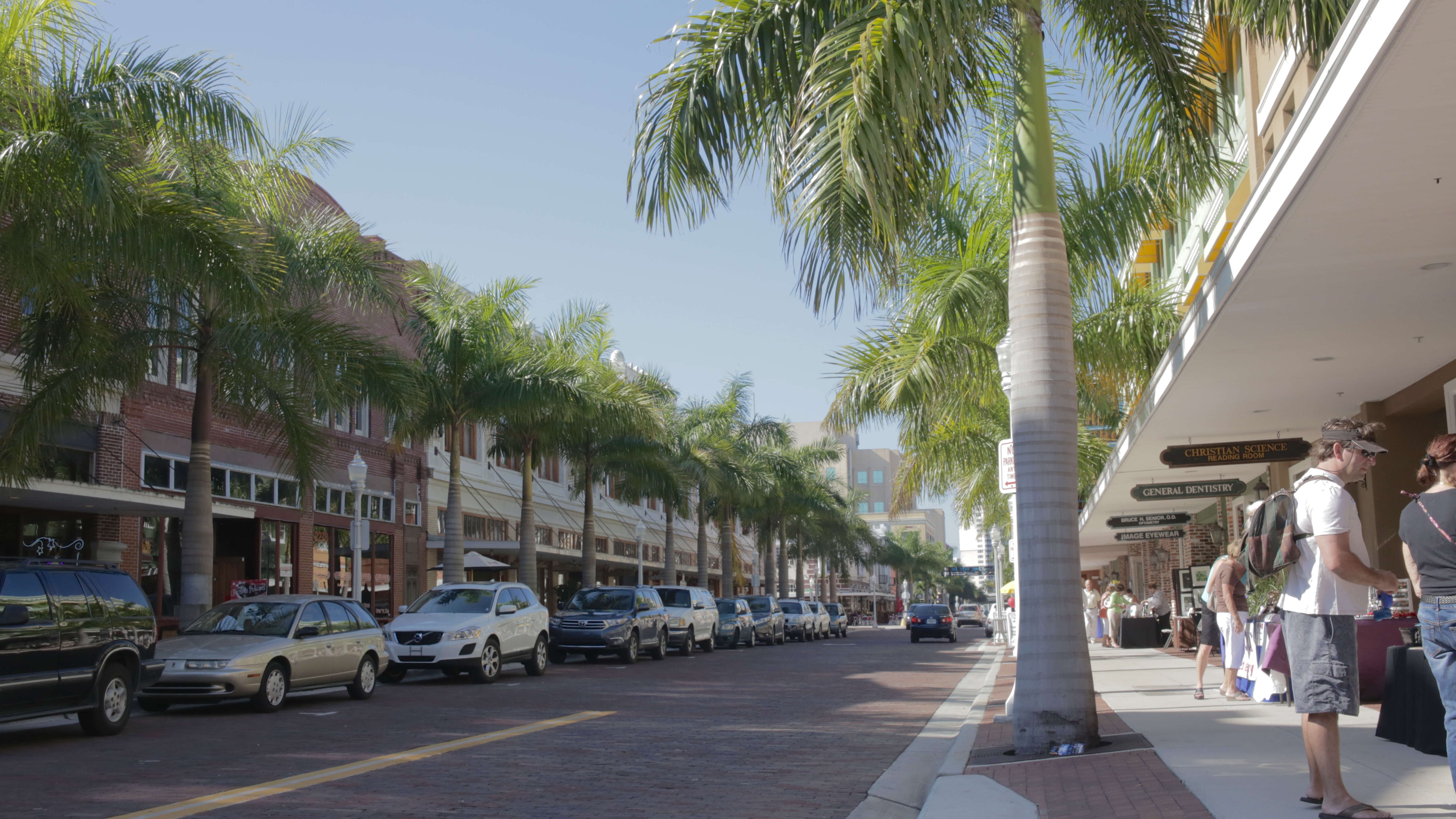
Downtown Fort Myers is known today as the River District, but beneath its restaurants, galleries and entertainment venues is a genuine historic commercial district. Today, historic buildings in Downtown Fort Myers house offices, restaurants, galleries and cultural organizations.
The Fort Myers Downtown Commercial District contains buildings dating from the late 19th century through 1939, reflecting the years when the city emerged as Lee County’s commercial and governmental center. The district was added to the National Register of Historic Places in 1990. The Arcade Theatre was built by Harvie and Gilmer Heitman in 1915 as a vaudeville and motion-picture theater, and in 1998, after years of sitting dark, the theater became home to Florida Repertory Theatre.
Dean Park
Dean Park is a historic residential district rather than a commercial destination. Although its National Register period of significance extends from the early through mid-20th century, much of its defining residential development occurred during Fort Myers’ early growth and 1920s boom.
The district is associated with community planning and development as well as architecture and was added to the National Register of Historic Places in 2013. Bungalows, porches, distinctive roof designs and residential homes make the transition from downtown Fort Myers noticeable.
Punta Gorda
Punta Gorda was originally registered as Trabue by Isaac H. Trabue in 1885 and incorporated as Punta Gorda in 1887. Its historic residential district preserves evidence of the city’s development from 1884 through 1930, including wood-framed houses, Victorian-style homes and masonry buildings.
Several historic roads retain their original brick pavers, and historic churches and Punta Gorda City Hall also sit within the district, which was added to the National Register of Historic Places in 1991.
In 2026, the city proposed a rewrite of its Historic Overlay District regulations that would update preservation procedures, reestablish local historic registers and revise rules governing demolition and relocation of historic buildings.
Made by water
Boca Grande
COURTESY PHOTO
Boca Grande, despite its polished appearance, was shaped by industry and transportation as much as by wealthy winter visitors.
Phosphate shipping helped drive development on Gasparilla Island, and the railroad connected the port at the island’s southern end to inland mining operations. Downtown Boca Grande developed around that transportation network in the early 20th century, as commercial and residential buildings clustered around Park and Palm avenues and the railroad.
The original Hotel Boca Grande opened in 1911 and was renamed The Gasparilla Inn in 1913. Guests arrived by train and private yacht, and tarpon fishing helped establish Boca Grande as a popular winter destination. After the causeway opened in 1958, railroad service to the island ended. Part of the old right-of-way became a public path through Boca Grande, allowing today’s walkers and cyclists to travel a route once used by trains.
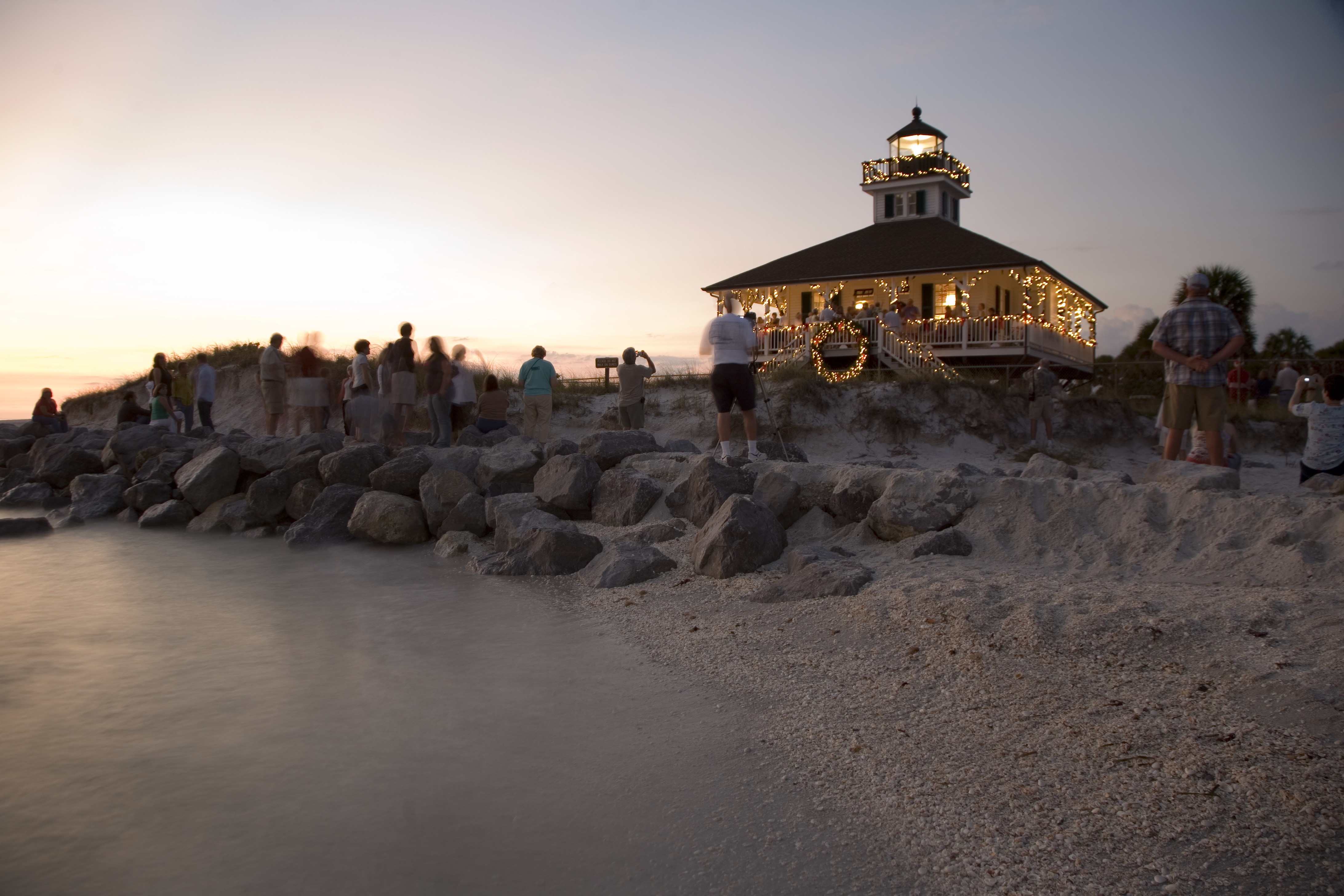
At the island’s southern end, the Port Boca Grande Lighthouse dates back to 1890 and today it houses a museum dedicated to Gasparilla Island history.
Pineland and Bokeelia
The Pineland Site Complex preserves roughly 2,000 years of human history, including more than 1,500 years of Indigenous occupation. It became one of the great towns of the Calusa, who built enormous shell mounds, engineered canals and developed a complex society sustained heavily by surrounding estuaries.
The Pineland Site Complex is listed on the National Register of Historic Places and designated as a Lee County historical resource. The Florida Museum of Natural History’s Randell Research Center manages nearly 70 acres of the site, which extends across more than 100 acres. Calusa Heritage Trail winds through archaeological mounds, wetlands and remnants of the canal system, and posted signs explain Calusa life and the environment that sustained it.
Farther north, Bokeelia reflects a later chapter of Pine Island history. Lee County formally designated the Bokeelia Historic District along Main Street in 1990.
Matlacha
Lee County designated the Matlacha Historic District in 1990, preserving part of a small waterfront community whose development was closely tied to fishing and island life. Historic-preservation regulations continue to govern how resources are designated within the district.
J.N. “DING” DARLING NATIONAL WILDLIFE REFUGE / COURTESY PHOTO
Sanibel and Captiva
The Sanibel Lighthouse dates to 1884, when settlement on the island was still sparse. Ferry service eventually connected Sanibel more directly with the mainland, and the opening of the Sanibel Causeway in 1963 transformed access to the island.
The Sanibel Historical Museum & Village preserves historic buildings, which were relocated and restored from locations around Sanibel. Visitors can also follow Sanibel’s Heritage Trail to explore the island’s history.
Captiva Island is five-mile stretch of barrier island located just north of Sanibel. Its small commercial area features eclectic restaurants, boutiques, and historic structures like the 1901 Chapel-by-the-Sea. While the northern end is anchored by the private South Seas Island Resort, the rest of the island maintains a quiet, residential feel where biking and golf carts are the preferred modes of transportation.
Heading inland
Immokalee
Immokalee’s history was influenced by cattle and agriculture rather than beachfront resorts. Indigenous people, including the Calusa and later the Seminole, were the early settled in the area before hunters, trappers, cowmen, missionaries, traders and settlers arrived. Settlement dates to 1872, and early pioneers adopted the name Immokalee in 1897.
The Immokalee Pioneer Museum at Roberts Ranch is a 13-acre historic site with 15 original buildings that illustrate life on an early Southwest Florida ranch, homestead and citrus grove.
In 2026, the museum’s Garden & Grove project recreated Sara Jane Roberts’ half-acre vegetable garden and restored 1.25 acres of the historic citrus grove. The project included more than 140 citrus trees, avocado and mulberry trees and seven raised vegetable beds whose produce is intended for local food pantries.
Combining the past with the future
Historic Southwest Florida isn’t frozen in time. Preservation in the region hasn’t meant restoring things exactly as they were — hurricanes, development, changing industries, population growth and generations of people influence the evolution the communities and continue writing Southwest Florida’s rich history.








Comment
Comments